Free Mindful Support
How Nature Supports Children’s Wellbeing – we spend a lot of time thinking about how to help children regulate, settle, and feel safe.
But when a parent or carer feels calmer, young people feel it too. And one of the simplest ways to get there doesn’t involve an app, a course, or a meditation cushion.
It just involves trees.
What the Science Says
Spending unhurried time in natural settings — woodlands, parks, even a garden — has measurable effects on our mental and physical wellbeing; mood lifts, stress hormones drop and the nervous system, which in many of us is quietly running on high alert, begins to settle.
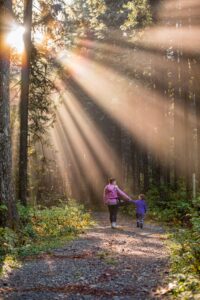
For young people the benefits are particularly striking:
- improved attention spans
- better emotional regulation
- stronger resilience and coping skills
- increased creativity and problem-solving
Dr Mary Carol Hunter at the University of Michigan describes it this way:
“Nature is fuel for the soul. Often when we feel depleted, we reach for a cup of coffee, but research suggests a better way to get energized is to connect with nature.”
Environmental psychologist Dr Rachel Kaplan agrees:
“Nature provides the right environment for developing skills like problem-solving, critical thinking, and decision-making.”
A study published in the Journal of Environmental Psychology found that spending time in nature significantly improved attention spans and increased creativity in children.
Desarrollar resiliencia y habilidades de afrontamiento – spending time in outdoor settings allows children to encounter challenges, overcome obstacles, and develop a sense of self-efficacy. According to the Asociacion Americana de Psicologia, la exposición a entornos naturales fomenta la resiliencia emocional y ayuda a los niños a afrontar el estrés y la adversidad de forma más eficaz.
For trauma-experienced children, The Children in Nature Network discovered that being in nature Reduce naturalmente el estado de hipervigilancia de su sistema nervioso debido a un trauma..
A survey of child and family service providers named five key outcomes as focus areas for intervention: healing, permanency, family connection, safety and self regulation.
Mindfulness in Nature – getting started
You don’t need to do anything complicated. Here are five ways to bring a little awareness to time outdoors — for the whole family.
1. Walking with the senses
The walking is not about your step count, but about noticing — feet on the ground, sounds, smells, the temperature of the air. You can gently point things out to children, or simply do it yourself to regulate your nervous system (which benefits those around you).
2. A nature treasure hunt
Before you head out, write a simple list together — a feather, something smooth, something that makes a sound, a colour you don’t often notice. Then slow right down and look. This works well for children who find stillness difficult, because the seeking is the mindfulness. Their nervous system settles without them realising it.
3. Stretching or yoga outside
Simple, slow movement in the garden or a park feels different to doing the same thing inside. Feel the ground, notice the air, breathe. For smaller kids get them to imitate the shape of a tree or flower they see around them.
4. Sitting beneath a tree
Find a tree, sit near it, and notice it — the bark, the leaves, the way the light shifts through the branches. Children can lie underneath and look up through the canopy. You can guide them to notice that the tree breathes in what they breathe out, and gives them back their next breath.
5. Journalling or drawing in nature
A notebook and a quiet spot outdoors can open something up in children. Encouraging them to draw, write, or simply doodle what they notice. The intention is just to be somewhere calm, with space to process whatever needs to.
Forest Bathing – a mindful practice
The Japanese have long practised what they call shinrin yoku — immersion in the forest atmosphere — and it’s now being widely studied as a therapeutic practice. But you don’t need a Japanese word for it or a special woodland to feel the effects. Even a few minutes of unhurried time in green space, done with a little awareness, can shift how both you and your child feel. If you need a little more information to explore the powerful effects of this practice, we recommend ‘*Into the Forest’ by Dr Qimg Li.
 We’ve just recorded a guided meditation set in a forest — for teens and adults — and it goes live on the Connected Kids YouTube channel at 8pm BST this Sunday, the Summer Solstice. A good one to try in nature (or simply at home) to help feel more grounded.
Recursos útiles
If you’d like support bringing practices like this into your family life or classroom, the Connected Kids Method walks you through everything step by step — including how to adapt mindful practices in nature for children with different needs.
*Amazon Associate, we earn from qualifying purchases on paid links.